How Digital Marketing Helps Businesses Grow in the Modern World
Why Is Digital Marketing Important for Businesses Today?
In today’s fast-paced digital world, customers no longer rely solely on newspapers, television advertisements, or word-of-mouth recommendations. Instead, they search online, compare options, read reviews, and make purchasing decisions through digital platforms. This shift in consumer behavior has made digital marketing one of the most powerful tools for businesses of all sizes.
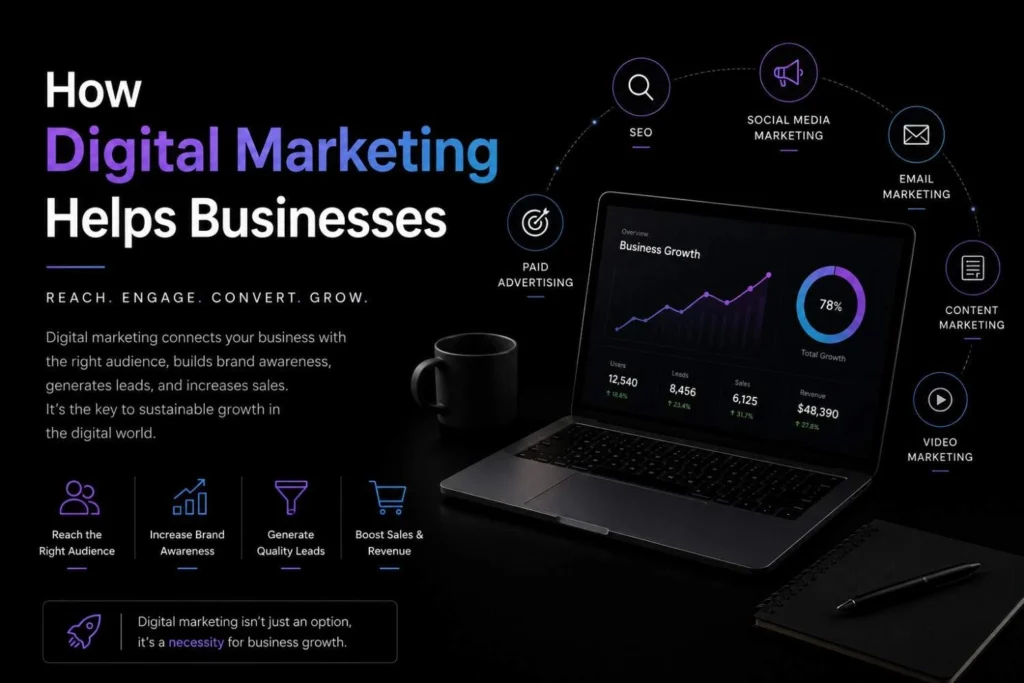
Whether you run a small local business, a startup, or a large corporation, digital marketing helps you reach the right audience, build brand awareness, generate leads, and increase sales more efficiently than many traditional marketing methods.
But what exactly makes digital marketing so important?
Let’s explore.
What Is Digital Marketing
Digital marketing refers to all marketing activities that use online channels and digital technologies to promote products or services. These channels include:
- Search Engines (Google, Bing)
- Social Media Platforms
- Websites and Blogs
- Email Marketing
- Content Marketing
- Online Advertising
- Video Marketing
- Mobile Marketing
The goal is simple: connect businesses with potential customers where they spend most of their time—online.
How Does Digital Marketing Help Businesses Grow?
1. Increases Brand Awareness
One of the biggest challenges for businesses is getting noticed.
Digital marketing allows brands to introduce themselves to thousands—or even millions—of potential customers. Through social media campaigns, search engine optimization (SEO), blog content, and online advertisements, businesses can consistently appear in front of their target audience.
The more frequently people see your brand, the more familiar and trustworthy it becomes.
For example, when someone repeatedly sees your business on Google searches, Instagram posts, or Facebook advertisements, they are more likely to remember your brand when they need your products or services.
2. Helps Reach the Right Audience
Traditional advertising often targets a broad audience, which can result in wasted marketing spend.
Digital marketing, on the other hand, enables businesses to target specific groups based on:
- Age
- Gender
- Location
- Interests
- Online behavior
- Purchase history
This precision targeting ensures that marketing efforts reach people who are genuinely interested in the business offerings.
As a result, businesses experience higher engagement rates and better returns on investment.
3. Generates High-Quality Leads
A lead is a potential customer who has shown interest in your business.
Digital marketing generates leads through:
- Search engine optimization
- Landing pages
- Social media campaigns
- Email marketing
- Paid advertising
Unlike traditional methods, digital marketing attracts people who are already searching for solutions. This means businesses can connect with prospects who are closer to making a purchasing decision.
High-quality leads often translate into higher conversion rates and increased revenue.
Can Digital Marketing Improve Customer Relationships?
Absolutely.
Building strong customer relationships is essential for long-term success.
Digital marketing allows businesses to engage directly with customers through:
- Social media interactions
- Email newsletters
- Personalized offers
- Online customer support
- Feedback surveys
When customers feel heard and valued, they are more likely to remain loyal to the brand.
Regular communication also helps businesses understand customer preferences and improve their products or services accordingly.
4. Improves Search Engine Visibility
Have you ever searched for a product on Google and clicked one of the first results?
Most consumers do exactly that.
Search Engine Optimization (SEO) helps businesses rank higher in search engine results pages. Higher rankings lead to:
- More website traffic
- Increased credibility
- Better brand visibility
- More sales opportunities
Businesses that invest in SEO can attract customers continuously without relying entirely on paid advertisements.
This makes SEO one of the most cost-effective digital marketing strategies available.
5. Provides Measurable Results
One major advantage of digital marketing is its ability to track performance.
Businesses can measure:
- Website traffic
- Click-through rates
- Conversion rates
- Customer engagement
- Advertising performance
- Return on investment (ROI)
This data allows companies to identify what works and what doesn’t.
Instead of guessing, businesses can make informed decisions based on real numbers and continuously optimize their marketing strategies.
Why Is Social Media Marketing So Effective?
Social media platforms have transformed the way businesses interact with customers.
Platforms like Facebook, Instagram, LinkedIn, YouTube, and TikTok provide opportunities to:
- Build communities
- Share valuable content
- Promote products
- Generate leads
- Increase brand awareness
Social media also encourages two-way communication, making it easier for businesses to engage with their audience in real time.
A well-executed social media strategy can significantly increase customer trust and brand loyalty.
6. Cost-Effective Marketing Solution
Many small businesses operate with limited marketing budgets.
Digital marketing offers affordable options compared to traditional advertising channels such as television, radio, or print media.
For example:
- Creating a blog is relatively inexpensive.
- Social media marketing can be started with minimal investment.
- Email marketing delivers high returns at a low cost.
- Paid advertisements can be scaled according to budget.
This flexibility makes digital marketing accessible to businesses of all sizes.
7. Supports Business Expansion
Digital marketing removes geographical limitations.
A local business can attract customers from neighboring cities, while an online store can reach customers across the country or even globally.
Through digital channels, businesses can:
- Enter new markets
- Reach international audiences
- Build partnerships
- Expand their customer base
This scalability is one of the primary reasons why digital marketing plays a crucial role in modern business growth.
How Does Content Marketing Contribute to Success?
Content marketing focuses on creating valuable and informative content that helps potential customers solve problems or answer questions.
Examples include:
- Blog articles
- Videos
- Guides
- Case studies
- Infographics
- E-books
High-quality content establishes authority and builds trust.
When businesses consistently provide useful information, customers begin to view them as industry experts. This trust often influences purchasing decisions and encourages customer loyalty.
8. Increases Sales and Revenue
Ultimately, every business aims to increase revenue.
Digital marketing supports this goal by:
- Driving targeted traffic
- Generating qualified leads
- Improving conversion rates
- Building customer trust
- Encouraging repeat purchases
Businesses that implement effective digital marketing strategies often experience steady growth in both customer acquisition and sales performance.
What Does the Future of Digital Marketing Look Like?
The future of digital marketing continues to evolve with advancements in technology.
Emerging trends include:
- Artificial Intelligence (AI)
- Voice Search Optimization
- Marketing Automation
- Personalized Customer Experiences
- Video Marketing
- Data-Driven Advertising
Businesses that stay updated with these trends will be better positioned to compete in increasingly digital marketplaces.
The companies that adapt early are often the ones that achieve sustainable growth and long-term success.
Conclusion
Digital marketing is no longer optional—it is an essential component of modern business strategy.
From increasing brand awareness and generating leads to improving customer relationships and driving sales, digital marketing provides businesses with powerful tools to grow efficiently and sustainably.
Its ability to target specific audiences, deliver measurable results, and operate cost-effectively makes it one of the most valuable investments a business can make.
As consumer behavior continues shifting toward digital platforms, businesses that embrace digital marketing will have a significant advantage over competitors who fail to adapt.
The question is no longer whether a business should invest in digital marketing. The real question is:
Can a business afford not to?


